
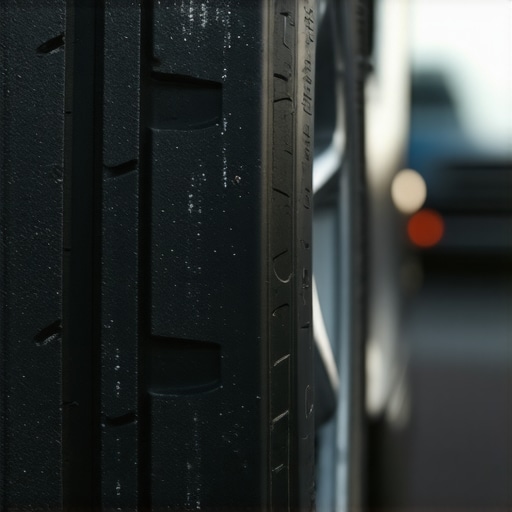
Why Your New Tires Are Wearing Fast on the Inside Edge
There is a specific kind of frustration that only a car owner knows: you just dropped $800, $1,000, or even $1,200 on a fresh set of premium tires. You expect a smooth ride and at least 40,000 to 60,000 miles of peace of mind. But then, just a few months later, you happen to glance at your front wheels while the steering is turned, and your heart sinks. The outer tread looks brand new, but the inner edge – the part closest to the engine – is worn down to the wear bars, or worse, the silver steel cords are starting to peek through the rubber.
My name is Ron Capozzi, and I’ve spent over 30 years in the automotive industry. From my early days as a tech at Atlantic Automall to running the operations here at m d automotive, I have seen thousands of sets of tires meet an early grave. When a customer comes into our shop with inside edge wear, they are often rightfully upset. They feel like they got a “bad batch” of tires. However, the truth is that tires are rarely the villain in this story; they are usually the victim. At md automotive repair, we specialize in identifying the mechanical culprits that turn expensive rubber into scrap metal prematurely.
In this guide, I’m going to break down exactly why your tires are balding on the inside and why simply buying another set of tires without a professional auto repair wheel alignment or vehicle suspension repair is a recipe for wasting money.
The Anatomy of Inner Tire Wear: What Are You Seeing?
Inner tire wear is often referred to as “stealth wear.” Because most drivers only see their tires from a standing side profile, the damage remains hidden under the wheel well. It isn’t until the vehicle is on a lift for an oil change or the wheels are turned to full lock that the carnage becomes visible. You might notice the inner third of the tire is significantly smoother than the rest, or you might feel a vibration in the steering wheel that wasn’t there before.
Technically, we categorize this wear into two main types: camber wear and toe wear. Camber wear looks like a smooth, consistent slope from the outside of the tire toward the inside. Toe wear, however, often looks “chopped” or “feathered,” where the rubber feels sharp when you rub your hand one way across the tread and smooth the other way. Understanding this distinction is the first step in a proper diagnosis. If you want to maximize your investment, learning How to Get More Life Out of Your Current Tires is essential, but it starts with a healthy vehicle foundation. At our tire shop auto repair center, we don’t just sell you rubber; we look at the “why” behind the wear.
Reason 1: Excessive Negative Camber
Camber is the measure of the vertical tilt of the wheels when viewed from the front of the vehicle. If the top of the tire tilts outward, it’s “positive camber.” If the top of the tire tilts inward toward the engine, it’s “negative camber.” While a tiny bit of negative camber can actually improve handling during high-speed cornering, excessive negative camber is a tire killer.
When your wheels have too much negative camber, the vehicle’s weight isn’t distributed evenly across the entire contact patch of the tire. Instead, the weight is concentrated on that inner shoulder. Imagine walking on the inside of your feet all day; your shoes would wear out on the inner sole very quickly. The same happens to your tires. This is a common issue we address during vehicle suspension repair.
What causes this tilt? In many cases, it’s sagging springs or worn-out struts. For our commercial clients using md fleet services, we often see negative camber caused by consistent heavy loading. When a van or truck is overloaded, the suspension compresses, often pushing the wheels into a negative camber state. Over time, this becomes the “new normal” for the vehicle, and the tires pay the price.
Reason 2: Improper Toe-Out Alignment
While camber is about tilt, “Toe” is about the direction the tires are pointing relative to each other. Think of it like being “pigeon-toed” or “duck-footed.” If the fronts of the tires point toward each other, it’s “toe-in.” If they point away from each other, it’s “toe-out.”
Toe-out is the most aggressive cause of inner tire wear. When your tires are pointing away from each other, they are effectively trying to drive in two different directions. As the vehicle moves forward, the tires are forced to “scrub” across the pavement. This scrubbing action acts like a belt sander on the inner edges of your tread. Even a fraction of an inch of toe-out can destroy a tire faster than almost any other alignment issue. This is why a precision auto repair wheel alignment is the most important service you can perform after installing new tires.
At m d automotive, we use state-of-the-art computerized alignment systems to measure toe down to the hundredth of a degree. Without this level of precision, you’re just guessing with your checkbook.
Reason 3: Worn Suspension Components
This is the “hidden” cause that many discount tire shops miss. You can put a car on an alignment rack and get the numbers into the “green” zone, but if the parts holding the wheel in place are loose, those numbers will change the moment you hit a bump on the road. This is where md auto repair expertise really shines.
Your vehicle’s suspension is a complex web of ball joints, control arm bushings, and tie rod ends. These components are usually cushioned by rubber bushings. Over time, that rubber rots, cracks, and compresses. When a bushing is worn, the control arm can move more than it’s supposed to. Under the load of braking or accelerating, a worn bushing can allow the wheel to shift into a negative camber or toe-out position dynamically. You might have a perfect alignment while the car is sitting still, but a terrible one while it’s moving.
If you suspect your parts are failing, you might want to read about How to Identify a Blown Shock Absorber by Looking at Your Tires or learn The Signs Your Struts are Finally Bottoming Out. Replacing tires without addressing a failing ball joint is like putting a Band-Aid on a broken leg. Comprehensive vehicle suspension repair is the only way to ensure your tires live their full life.
Why Suffolk County Drivers Face Unique Alignment Challenges
Driving in Suffolk County, New York, isn’t like driving in the suburbs of the Midwest. We deal with a unique set of environmental stressors that wreak havoc on steering and suspension systems. Between the potholes on the Long Island Expressway and the stop-and-go traffic on Sunrise Highway, our vehicles take a beating.
One major factor we see at m & d auto repair is salt corrosion. The salt used on our roads in the winter is incredibly corrosive to the adjustment bolts used for alignments. Often, these bolts become “seized,” meaning they won’t turn. A standard shop might just tell you they “did their best,” but at m d automotive, we have the tools and experience to deal with New York rust. Furthermore, the constant vibration from uneven pavement can slowly “walk” your alignment out of spec over the course of a single season. We also recommend a suffolk county brake service check during your alignment, as sticking calipers can also contribute to uneven tire heat and wear.
The M&D Automotive Diagnostic Process
When you bring your vehicle to md automotive, we don’t just slap it on the rack and call it a day. We follow a rigorous diagnostic process to ensure we are fixing the root cause of your tire wear. As an auto engine repair shop and full-service facility, we look at the vehicle as a complete system.
- Pre-Alignment Inspection: We lift the vehicle and physically shake down the front end. We check for play in the ball joints, tie rods, and wheel bearings. If these parts are loose, an alignment is a waste of time.
- Tire Pressure Calibration: You’d be surprised how many alignment issues are actually just vastly different tire pressures. We set everything to factory specs first.
- Computerized Measurement: We use high-definition cameras and sensors to map the current geometry of your wheels.
- The Adjustment: I personally oversee our technicians to ensure that we aren’t just getting the numbers “in the green,” but that we are centering them for the best possible tire life.
- Test Drive: We verify that the steering wheel is centered and the vehicle tracks straight under real-world conditions.
Whether you need an auto exhaust repair shop or a precision alignment, our process remains the same: do it right the first time.
Can You Fix Inner Tire Wear Yourself?
I’m a big fan of the DIY community. I started by turning wrenches myself, and I encourage people to understand their vehicles. However, when it comes to alignment, there are limits to what you can do in a driveway. You can certainly learn How to Check Your Tie Rod Ends with Minimal Tools to see if you have a major failure, but you cannot perform a precision alignment with a tape measure and a level.
Modern vehicles have tolerances measured in millimeters. A “close enough” DIY alignment might stop the car from pulling to the right, but it won’t stop the “scrubbing” that eats your tires. If you see inner edge wear, the best DIY move you can make is to stop driving on it and get it to a professional. Driving on tires with exposed cords is a safety hazard – not just for you, but for everyone else on the road.
Beyond Tires: Other Critical Maintenance to Check
While your car is on the lift at our tire shop auto repair center, it is the most cost-effective time to look at other preventative maintenance. A vehicle that has alignment issues often has other neglected areas because the owner didn’t realize how quickly things were degrading.
For instance, if your suspension is worn, your braking distances are likely increased. This is the perfect time for a brake auto repair shop inspection. Similarly, if you’re preparing for a Long Island summer, having us look at your auto shop ac repair needs can save you a second trip to the shop later. We recommend checking out our Ultimate Car Service Guide: When and Why to Schedule Maintenance and Understanding Brake System Repairs: A Guide for Vehicle Owners to stay ahead of the curve. At md auto, we believe that an ounce of prevention is worth a pound of cure – and several hundred dollars in tires.
Conclusion: Protecting Your Investment
New tires are a significant investment in your vehicle’s safety and performance. Seeing them disappear before your eyes because of inner edge wear is frustrating, but it is a problem that can be solved. Remember: the tires are usually showing you a symptom of a deeper issue within your vehicle suspension repair needs or your auto repair wheel alignment settings.
Don’t let a bad alignment steal the life of your tires. Whether you are a local commuter or managing a fleet through md fleet services, the team at m d automotive is here to help. With my 30+ years of experience and our commitment to the Suffolk County community, we will diagnose the root cause of your tire wear and get you back on the road with confidence.
Ready to save your tires? Contact m & d auto repair today to schedule your precision alignment and suspension inspection. Let’s make sure those new tires last as long as they were meant to.