
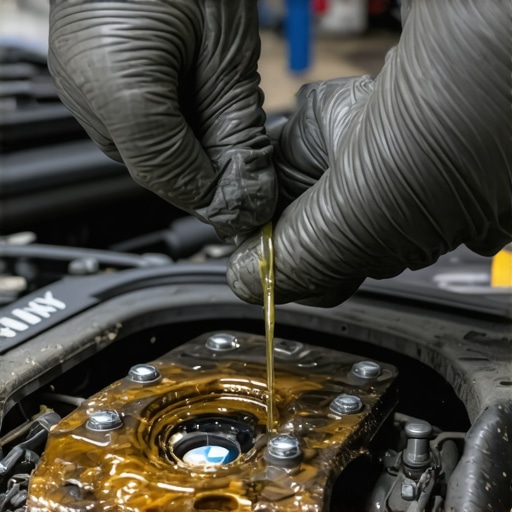
Why Your BMW Oil Leak Needs Immediate Attention From Specialists
Owning a BMW is a commitment to the “Ultimate Driving Machine.” It is a pledge to appreciate high-performance engineering, near-perfect weight distribution, and the visceral thrill of a precision-tuned engine. However, that precision comes with a caveat: the tolerances in a German-engineered powertrain are remarkably tight. As a Level 1 BMW Master Technician with years of factory training in Libertyville, IL, I have spent my career diagnosing the nuances of these vehicles – from advanced Diesel systems to the latest EV platforms. My name is Adam Fiedorowicz, and I have seen firsthand how a seemingly minor “drip” on a garage floor can escalate into a five-figure engine replacement in a matter of miles. While all cars may eventually leak, a BMW oil leak is a ticking time bomb that requires more than just a generic fix.
The reality is that many owners treat an oil leak as a cosmetic nuisance or a minor maintenance item. In a domestic truck or a standard commuter car, you might get away with that for a while. In a BMW, the proximity of oil seals to critical components like the serpentine belt and the cooling system makes any leak a high-priority emergency. To protect your investment, you need to understand the best way to spot an oil leak early before the damage becomes irreversible.
The “Big Three” Common BMW Oil Leaks
In the world of BMW repair, we frequently encounter the “Big Three.” These are failure points that affect almost every model from the E90 3-series to the modern G-chassis vehicles. Specifically, engines like the N20 and N26 (4-cylinders) and the legendary N54 and N55 (6-cylinders) are notorious for these issues.
1. Valve Cover Gasket (VCG)
BMW valve covers are often made of a high-grade plastic composite. Over thousands of heat cycles, the rubber gasket underneath becomes brittle and hard like plastic. Worse, the plastic cover itself can warp or develop hairline fractures. When the VCG fails, oil often leaks onto the exhaust manifold. This creates that distinct burning smell inside the cabin, which is more than just an annoyance – it’s a fire hazard. If you detect this, you should read why you should never ignore a burning oil smell immediately.
2. Oil Filter Housing Gasket (OFHG)
This is arguably the most dangerous leak in the BMW catalog. The oil filter housing sits directly above the serpentine belt. When the gasket fails, oil seeps down and saturates the rubber belt. Oil acts as a solvent on rubber; it causes the belt to swell, soften, and eventually slip or snap. In a BMW, a snapped belt doesn’t just mean you lose power steering – it can mean the end of your engine (more on that below).
3. Oil Pan Gasket
The oil pan gasket is a labor-intensive oil pan repair. Unlike a standard vehicle where the pan is easily accessible, BMW’s front-engine, rear-wheel-drive (or xDrive) layout requires the technician to support the engine from above and “drop” the front subframe to gain access. This is a complex procedure involving the steering rack and suspension components. It is not a job for a generalist; it requires specialized alignment and torque-to-yield bolt replacement that only a specialist shop like AutoLab Libertyville can provide.
The Catastrophic “Belt Ingestion” Scenario
Why do I emphasize the urgency of an oil leak repair so strongly? It comes down to a design quirk involving the front main seal and the crank pulley. When an Oil Filter Housing Gasket leaks, the oil compromises the integrity of the serpentine belt. If that belt slips off the pulley, the rotation of the engine can actually “suck” the shredded belt behind the harmonic balancer and through the front main seal.
Once the belt is inside the engine, it gets pulverized into the oiling system. These rubber shards quickly migrate to the oil pickup tube, clogging it and starving the engine of lubrication. I have seen N55 engines seize completely within minutes of a belt failure. This turns a $600 gasket repair into a $15,000 engine replacement. This isn’t hyperbole; it is a documented mechanical reality for BMW owners. This is exactly how this local shop saved my engine from seizing for many of our clients who caught the leak just in time.
Why Generalist Shops (CarMax, VW, etc.) Aren’t Enough
Many Libertyville drivers consider carmax servicing or visiting a libertyville vw dealer for their BMW needs, thinking an oil leak is a universal problem. While a carmax service department or a carmax repair shop is perfectly capable of handling a carmax oil change or perhaps finding the best jeep service near me, they often lack the specialized diagnostic software and technical training specific to BMW’s Valvetronic and VANOS systems.
A carmax car service might identify a leak, but do they know that BMW uses aluminum torque-to-yield bolts that must be replaced every single time they are loosened? If a generalist shop reuses these “one-time use” bolts, they will eventually snap or lose their clamping force, leading to a recurring leak or worse. When you search for auto repair libertyville il or libertyville car repair, you aren’t just looking for a wrench; you are looking for a specialist who understands that a BMW is not a Volkswagen or a Jeep. Our team at auto lab has the factory-level ISTA diagnostic tools that general shops simply don’t invest in.
Advanced Diagnostics: Beyond the Visual Inspection
At AutoLab Libertyville, we don’t guess; we diagnose. Sometimes an oil leak is obvious, but often it is masked by the engine’s plastic under-shielding. We utilize UV dye tests to trace the exact origin of a leak. Furthermore, we often find that oil leaks coincide with evaporative emission system repair needs. If your BMW has an evap system leak detected (common codes like P0456 or P0442), it can sometimes be linked to the health of the valve cover and its integrated PCV (Positive Crankcase Ventilation) system.
We use high-end smoke machines to find these leaks. This is a critical step because a vacuum leak in the EVAP system can cause the engine to run lean, increasing operating temperatures and further degrading your oil gaskets. Understanding how to find an evap leak using a simple smoke machine is a standard part of our comprehensive diagnostic approach. We ensure that when we fix an oil leak, we are also addressing the underlying pressure issues that might have caused it in the first place.
Navigating Warranty and Payments: MaxCare & Synchrony
We understand that bmw oil leak repair, particularly for an oil pan, can be a significant investment. This is why AutoLab Libertyville is a preferred provider for MaxCare, the extended warranty offered through CarMax. If you purchased your BMW and have a MaxCare plan, we can handle the claims process for you, ensuring that your vehicle gets Master Tech level service while your warranty covers the bill. For more details, check out what Libertyville drivers need to know about MaxCare warranty repairs.
For those without warranty coverage, we offer Synchrony Car Care financing. This allows you to break up the cost of critical repairs into manageable monthly payments. We believe that financial constraints shouldn’t stand between you and a safe, functional vehicle. Whether it is an oil change carmax customers need or a complex transmission leak repair fluid service, we provide the financial flexibility to get it done right the first time.
The Difference Between a Patch and a Professional Repair
I often see cars come into the shop after the owner has tried a “stop leak” additive. Let me be clear: stop leak products are poison for a BMW. These additives work by swelling seals, but in a BMW, they can clog the tiny oil passages in the VANOS (variable valve timing) solenoids and the Valvetronic eccentric shaft sensors. A $30 bottle of chemicals can easily cause $3,000 in damage to your timing system.
A professional repair at AutoLab involves using OEM gaskets and, crucially, replacing all necessary hardware. For example, when performing a transmission leak repair fluid service, we only use ZF LifeGuard fluid, as specified by the transmission manufacturer. Using a generic “multi-vehicle” fluid can lead to harsh shifts and premature clutch wear. We treat every fluid and every bolt as a critical component of the engine’s ecosystem. This level of detail is what separates a Master Technician from a general mechanic.
Don’t Let a $500 Leak Become a $15,000 Engine
The engineering of a BMW is a double-edged sword. It provides unparalleled performance when maintained but offers very little margin for error when neglected. An oil leak is never “just a leak” on a BMW; it is a symptom of degrading components that can lead to total engine failure through belt ingestion or oil starvation. As a Level 1 Master Tech, my goal is to keep your vehicle on the road and out of the scrap yard.
If you have spotted a spot on your driveway, smell burning oil, or have been told by a general shop that you have a “minor leak,” don’t wait. Contact AutoLab Libertyville today to schedule a specialized BMW inspection. Let us provide the precision care your Ultimate Driving Machine deserves.