
How to Tell if Your Local Mechanic Actually Has the Tools for a Proper ADAS Calibration
My name is Nate Barnhurst. I am an ASE Master Automotive Diagnostic Technician and an ADAS Programming and Calibration Specialist. With over 20 years of experience in automotive management and hands-on diagnostics, I’ve seen the industry shift from mechanical linkages and carburetors to what we have today: computers on wheels. Modern vehicles are no longer just machines; they are sophisticated mobile networks where a single sensor can dictate whether your car stays in its lane or steers you into a ditch.
Advanced Driver Assistance Systems (ADAS) – which include features like Adaptive Cruise Control (ACC), Lane Keep Assist (LKA), Automatic Emergency Braking (AEB), and Blind Spot Monitoring – rely on a delicate ecosystem of cameras, radar units, and ultrasonic sensors. When these systems work, they save lives. When they are miscalibrated, they become a liability. The most dangerous phrase in the modern auto repair shop today is: “There are no lights on the dash, so it’s fine.”
In the world of high-level diagnostics, we have a mantra, originally championed by the experts at Protech: “Cleared is not Calibrated.” Just because a technician can plug in a $200 code reader and clear a “check engine” or “service radar” light doesn’t mean your car is safe to drive. Today, I’m going to teach you how to look past the lobby coffee and the service advisor’s smile to see if your mechanic actually has the technical infrastructure to handle your vehicle’s safety software.
Why “No Dashboard Lights” Doesn’t Mean Your Car is Safe
The biggest misconception among car owners is that the car’s computer is smart enough to know when it’s wrong. It isn’t. If a forward-facing camera is physically tilted two degrees to the left due to a poor windshield installation or a minor fender bender, the computer may still see “road” and “lines.” It assumes the camera is mounted perfectly according to OEM (Original Equipment Manufacturer) specifications. It has no internal level to tell it otherwise.
According to research by AAA, ADAS sensors are so precisely aimed that even a 1-degree offset can result in the system “looking” 40 feet off-target by the time the signal reaches the road ahead. If your Adaptive Cruise Control thinks the car in the lane next to you is actually directly in front of you, it may slam on the brakes at 70 mph. Conversely, it might fail to see a stalled vehicle in your actual path until it is too late.
Shops that simply “clear codes” are essentially telling the car to ignore its last recorded error. They aren’t verifying that the sensor’s field of vision aligns with the vehicle’s thrust line. This is why you must ensure your mechanic near me is doing more than just looking for a “clean” dashboard.
The “When” Factor: Does Your Mechanic Know When Calibration is Required?
A major red flag is a shop that performs significant structural or electronic work but never mentions calibration. You need to be your own advocate. Calibration isn’t just for when a sensor is replaced; it is required whenever the sensor’s “mounting environment” is disturbed. This includes:
- Windshield Replacement: Most modern cars have a forward-facing camera mounted to the glass. If that glass is replaced, the camera MUST be calibrated. Ignoring this is the danger of driving with a cracked windshield during a heatwave – it’s a safety compromise that can lead to catastrophic failure.
- Wheel Alignments: If you are looking for an alignment near me, you must ask if they can reset the Steering Angle Sensor (SAS). If your wheels are straight but your SAS thinks the wheel is turned 3 degrees, the Stability Control will fight you every mile. You can often tell if your alignment is off by looking at your steering wheel, but you can’t tell if the software knows where “center” is without a scan tool.
- Suspension Repairs: Changing struts or control arms alters the ride height and chassis angle. If the car sits half an inch lower, the radar is now aiming at the asphalt instead of the bumper of the car ahead.
- Tire Changes: Believe it or not, significant changes in tire diameter can affect ADAS. You should stop buying new tires until you check these three alignment signs to ensure your chassis is a stable platform for your sensors.
The Physical Evidence: What a Real ADAS Setup Looks Like
If you walk into a shop and they claim to do ADAS calibration, but the shop floor is cluttered, greasy, and cramped, they are likely lying to you – or at least doing it wrong. Proper calibration requires a controlled environment. Here is what you should look for:
1. The Calibration Frame (The Autel IA900 and Others)
High-end shops invest in heavy-duty hardware. Look for a large, metallic frame (often looking like a high-tech goalpost) positioned in front of or behind a vehicle. Systems like the Autel IA900 are the gold standard because they integrate wheel alignment and ADAS calibration into one workflow. This ensures the sensors are calibrated relative to the wheels, not just the body of the car.
2. Level Floors are Non-Negotiable
This is the most common failure point for local shops. ADAS calibration requires a floor that is level within millimeters. If the floor slopes even slightly, the “static” targets used to aim the camera will be at the wrong height or angle relative to the car’s pitch. Ask the shop: “Is your ADAS bay floor level-certified?” If they look at you sideways, they haven’t done their homework.
3. Controlled Lighting and Space
A proper ADAS bay needs a “clean” field of vision. This usually means a dedicated area of roughly 30 feet by 15 feet. There should be no reflective surfaces (like toolboxes or glass doors) behind the targets, and no direct sunlight hitting the camera lens during the process. If the shop is trying to calibrate a car in a busy thoroughfare where people are walking between the car and the target, the calibration will fail or, worse, be inaccurate.
4. Physical Targets
You should see boards with specific patterns – checkerboards, circles, or triangles. These are not “generic” posters. Each vehicle manufacturer (Honda, Toyota, Ford, etc.) has specific target patterns and sizes. A shop that has a diverse library of these physical targets is a shop that has invested tens of thousands of dollars into your safety.
Static vs. Dynamic Calibration: Why Your Shop Might Need Both
Not all calibrations happen in the shop. Depending on the make and model, your vehicle may require a Static Calibration, a Dynamic Calibration, or both. Knowing the difference helps you determine if your car needs a simple tune up or a major repair regarding its electronics.
Static Calibration is performed inside the shop using the frames and targets mentioned above. The vehicle is parked, and the technician uses lasers to align the targets perfectly with the vehicle’s center line. This is common for Honda, Toyota, and many European brands.
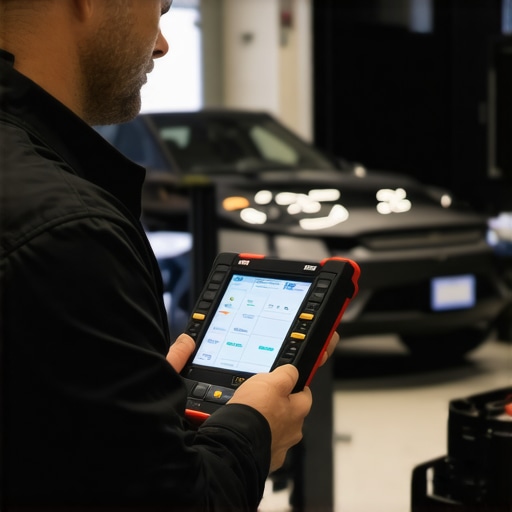
Dynamic Calibration involves a “learning” drive. The technician connects a diagnostic tablet and drives the vehicle on the road under very specific conditions (e.g., maintaining a speed of 40 mph on a road with clear lane markings and no shadows). Many Ford and GM vehicles rely heavily on this method.
The expert insight here is that many modern vehicles now require a “dual-stage” process. For example, some Mazdas require a static setup to “find” the camera’s position, followed by a dynamic drive to “verify” it. If your shop doesn’t understand the specific OEM requirements for ADAS calibration for your specific VIN, they are guessing. And in this business, guessing is dangerous.
5 Questions to Ask Your Mechanic Before Handing Over the Keys
Before you leave your car at any auto repair shop, put them through “The Acid Test.” A qualified technician will appreciate these questions; an unqualified one will get defensive.
- “Do you provide a pre-scan and post-scan report?” A pre-scan identifies existing “ghost” codes. A post-scan proves that the systems are communicating correctly after the repair. If they don’t provide a printout, they didn’t do the work.
- “Is your floor level-certified for ADAS work?” As mentioned, if the floor isn’t level, the calibration is a lie.
- “Do you use OEM-specific targets or universal ones?” While some high-quality aftermarket targets work, the shop should be able to explain how their targets meet the manufacturer’s specs.
- “Will you provide a digital certificate of calibration?” Modern tools like the Autel IA900 generate a PDF certificate showing the exact measurements and successful completion of the calibration. This is your “receipt” for safety.
- “Did this repair involve an alignment near me that requires a steering angle sensor reset?” This is the most skipped step in the industry. If they did an alignment but didn’t plug in a scan tool to “zero” the steering wheel in the computer’s brain, the job is half-finished.
Understanding these requirements is as vital as knowing the real cost of skipping your 100,000 mile major service. It’s not just about maintenance; it’s about the integrity of the vehicle’s safety net.
Red Flags: When to Walk Away from an Auto Repair Shop
In the technician community, there is a small but vocal group that views ADAS calibration as a “money grab” or an unnecessary upsell. This is a massive red flag. If you hear any of the following phrases, take your keys and leave:
- “The light went off on its own after I drove it, so it’s fine.” (This often means the system has simply stopped trying to calibrate and has entered a ‘fail-safe’ mode where features are disabled without a warning).
- “We don’t need those fancy targets; we just use a tape measure and a piece of cardboard.” (Precision matters down to the millimeter; cardboard doesn’t cut it).
- “The camera is behind the glass, we didn’t even touch it.” (If the glass was replaced, the refractive index of the new glass – even OEM glass – is different enough to require a recalibration).
A reputable auto repair shop will be transparent about the complexity of these systems. They will show you the equipment and explain the process. If they treat ADAS like a “black box” that they don’t want to deal with, they aren’t qualified to fix a modern car.
Conclusion: Your Safety is in the Software
We’ve moved past the era where a “good mechanic” was just someone who was good with a wrench. Today, a good mechanic must be part software engineer and part physicist. ADAS is not a luxury; it is a critical safety system that functions as your second set of eyes on the road.
When you look for a mechanic near me, don’t just look for the lowest price. Look for the shop that has invested in the Autel IA900, the shop that understands the “Cleared is not Calibrated” philosophy, and the shop that treats your car’s software with the same respect as its engine. Your life, and the lives of your passengers, depend on those sensors being aimed exactly where they need to be. Don’t settle for anything less than a certified, documented calibration.