

I remember the first time it happened to me. I was cruising down the interstate, humming along to the radio, when a tiny orange horseshoe started flashing on my dashboard like a frantic distress signal. My stomach did a somersault. Usually, that tire pressure light—the TPMS icon—just glows steady when things are a bit low on air. But a blink? That felt urgent. I pulled over immediately on a narrow shoulder, expecting to find a tire flatter than a pancake. To my surprise, all four tires looked perfectly fine. I felt like I was losing my mind. It was a classic case of not knowing the secret code our cars use to talk to us. If you are staring at that same blinking light right now, take a deep breath. You aren’t necessarily looking at an imminent blowout, but your car is definitely trying to tell you something different than a standard low-air warning. Today, I am going to help you decode that flashing icon so you can stop guessing and start fixing.
The Secret Language of Your TPMS Light
Most of us are used to the standard add air warning. You see the light, you check your pressures, and you fill them up. It is part of any regular car service routine. But when that light flashes for 60 to 90 seconds before staying solid, the rules of the game change completely. It usually means the system itself has a headache. Back when I first started working on my own rigs, I made the huge mistake of thinking a blinking light was just a soft warning for low pressure. I kept adding air until I nearly overinflated my tires, only to realize the light would not go away because the sensor inside the wheel had actually died. Do not be like younger me; check your actual pressures with a gauge first. If the air is fine but the light is blinking, you are likely dealing with a sensor malfunction or a dead battery in the transmitter. Have you ever felt that sinking feeling when a new light pops up and you have no idea what it means? It is incredibly frustrating. According to the experts at the National Highway Traffic Safety Administration, TPMS sensors typically last about 5 to 10 years, which is a detail many owners overlook until they start blinking.
Is this just another way for mechanics to take my money?
I get the skepticism. It feels like every beep and blink is just a dollar sign for the local garage. But ignoring a blinking TPMS light can actually lead to bigger auto repair issues down the line, especially if you can no longer tell when a tire actually loses air. If you have recently tried to repair a puncture yourself, make sure you used the correct way to use fix-a-flat, because some sealants can actually gunk up those expensive sensors and cause the very blinking light we are talking about today. We are going to dive into exactly how to reset this thing and when you truly need to call in the pros. We will look at why temperature swings play a role and how to tell if your battery is just giving up the ghost.
Rule Number One: Grab a Manual Gauge Before You Panic
The very first thing you must do when that light starts flashing is verify the physical reality of your tires. Do not rely on the dashboard display for this specific step. Sensors are essentially tiny computers living in a harsh environment of heat, centrifugal force, and road salt; they can and do lie. Use a high-quality digital or stick gauge to check all four tires. If they are all within 1-2 PSI of the recommendation found on your driver-side door jamb, you have officially confirmed a system error rather than a safety emergency. I once spent forty-five minutes at a gas station in the pouring rain, obsessively checking and re-checking my pressures because I didn’t trust my gauge. It turns out, I was looking for a problem that wasn’t there. By incorporating this manual check into your car service checklist, you save yourself the mental tax of wondering if a blowout is imminent while you are troubleshooting common auto repair issues. 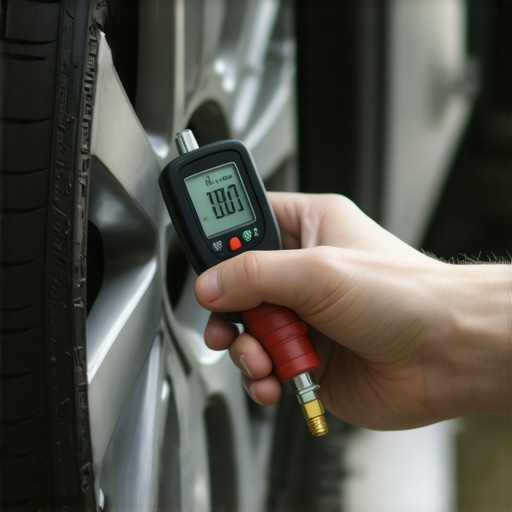
Check the Fifth Wheel That Everyone Forgets
Here is a pro tip that took me years to learn: check your spare tire. Many modern SUVs and trucks have a TPMS sensor inside the full-sized spare tucked under the chassis or in the trunk. If that spare drops below the threshold, the light will flash or stay solid, and you will drive yourself crazy checking the four wheels on the ground. I had a client once who was convinced his car was possessed because the TPMS light would only come on during long highway drives. We eventually found that the spare tire under his truck bed was just at the edge of the pressure limit, and the heat from the exhaust was causing the pressure to fluctuate just enough to trigger the sensor. Before you think you need to stop buying new tires or jump into expensive repairs, verify that ‘hidden’ fifth sensor.
The Relearn Procedure Often Requires a Specific Drive Cycle
If you have confirmed your pressures are perfect and the light is still flashing, your car likely needs a ‘relearn’ or a hard reset. This isn’t as scary as it sounds. For many vehicles, this involves a specific sequence, like turning the key to the ‘on’ position without starting the engine and holding a TPMS reset button (usually hidden under the steering column or in the glove box) until the light blinks three times. However, the most common ‘fix’ is simply a steady drive. Most systems need to see a constant speed of over 25 MPH for at least 10 to 20 minutes to recalibrate the sensors and confirm that the batteries are sending a strong signal. If you recently had work done on your wheels, you might notice the reason your brake pedal feels different after a tire change is often linked to the same technician handling your wheels and potentially bumping a sensor.
When the Scan Tool Becomes Your Best Friend
If the light persists after a drive, the issue is likely a dead battery in the sensor itself. Since these batteries are sealed inside the sensor unit, you cannot just swap them out; you have to replace the whole sensor. This is where a specialized TPMS scan tool comes in. These tools can ‘ping’ each wheel while the car is stationary to see which sensor is not responding. I remember trying to guess which sensor was bad by letting air out of each tire one by one to see if the dash updated—it was a nightmare and didn’t work on my older system. A quick scan by a pro or a high-end DIY tool would have told me in seconds that the front-left sensor had simply gone dark after seven years of service.It is easy to think that if your dashboard isn’t lit up like a Christmas tree, your car is in peak condition. However, the biggest myth in modern auto repair is that the computer catches everything immediately. In reality, sensors often only report data when it falls outside a pre-programmed ‘tolerance window.’ This means your car could be running inefficiently for months—slowly killing your gas mileage—before a ‘Check Engine’ or TPMS light ever appears. When I look at how regular tune-ups improve fuel efficiency and safety, I am not just looking for broken parts; I am looking for ‘lazy’ sensors that are technically functioning but performing poorly. This nuanced approach is what separates a basic oil change from a professional car service checklist.
Does Your Local Shop Actually Have the Tech for Modern ADAS Calibration?
As vehicles become more complex, the hardware is only half the battle. If you have a car made in the last five years, your TPMS system is often integrated with your Advanced Driver Assistance Systems (ADAS). If a technician swaps a sensor or aligns your wheels but does not recalibrate the cameras or radar, your safety features might be ‘blind.’ It is vital to know if your local mechanic actually has the tools for a proper ADAS calibration before you drop your keys on the counter. A study by the Car Care Council found that a staggering 80% of vehicles on the road failed at least one part of a basic safety inspection, proving that what we do not see is often what hurts our wallets the most. 
The Lubrication Trap That Ruins Your Brand New Brake Pads
One of the most common ‘oops’ factors I see involves DIY brake jobs. People often assume that ‘grease is grease,’ but using the wrong lubricant on slide pins is a death sentence for your calipers. Petroleum-based greases will cause the rubber dust boots to swell and eventually seize the caliper, leading to that dreaded scenario where your brakes are dragging in the rear or front without you even realizing it. This is one of the biggest brake service myths—that the pads are the only thing that matters. In truth, the hardware and lubrication points are what determine if those pads last 10,000 miles or 50,000 miles. Furthermore, if you have ever noticed the reason your brake pedal feels different after a tire change, it might be due to a technician over-torquing your lug nuts with an impact wrench, which can actually warp your rotors and create a pulse when you stop. If you have ever followed a tutorial only to have a new noise pop up a week later, you have probably fallen into one of these professional traps. Have you ever fallen into this trap? Let me know in the comments. If you are struggling with a mystery sound or a light that won’t stay off while troubleshooting common auto repair issues, feel free to contact us and we can help you figure out if it is a simple fix or something that needs a professional touch.To really stay ahead of the curve, you have to stop thinking of your car as a collection of metal gears and start seeing it as a rolling network.
The One Tool I Refuse to Work Without
The single most important addition to my garage in the last decade wasn’t a bigger torque wrench; it was a bidirectional OBDII scanner. Unlike those cheap $20 readers that just clear codes, a bidirectional tool lets you actually talk back to the car—you can command the fuel pump to turn on or test an individual fuel injector right from the screen. If you aren’t ready for that investment, at least learn how to test your alternator with a simple multimeter at home. This $15 tool has saved me more times than I can count by identifying a failing diode before it left me stranded in a grocery store parking lot. I’ve seen dozens of cases where a supposed ‘transmission problem’ was actually just a corroded ground wire confusing the computer, and you can easily learn how to tell if your electrical problem is a blown fuse or a bad ground wire with that same multimeter.
How do I keep my car running past 200,000 miles?
The secret isn’t some magic oil additive; it is consistency and documentation. You need to maximize your cars lifespan with expert tune-up strategies by sticking to a rigid schedule, even when the car feels ‘fine.’ I keep a literal logbook in my glovebox. Every time I hear a faint squeak or notice a 1 MPG drop, it gets written down. This allows me to spot patterns. According to the Society of Automotive Engineers (SAE) J1979 standard, the diagnostic data your car generates every second is incredibly granular; by monitoring ‘Long Term Fuel Trims’ with a scanner, you can see an engine vacuum leak developing weeks before it ever triggers a light. Ignoring these small signs is how people end up paying the real cost of skipping your 100000 mile major service, which often results in a bill four times higher than the preventative care would have been. #IMAGE_PLACE_HOLDER_D#
The Future is Moving Away from the Wrench
We are entering an era where ‘tuning up’ a car looks more like a software update than a spark plug change. As we look at auto repair trends to watch in 2025, we are seeing ‘Over-the-Air’ (OTA) updates fixing everything from braking distances to battery management systems. However, this tech-heavy shift makes the physical basics even more critical. A software update won’t fix a torn CV boot or a seized brake caliper. My advice? Grab a basic digital multimeter this weekend and test your battery voltage while the engine is off and while it is running. It is the single simplest diagnostic habit you can form to take control of your vehicle’s health and ensure your tune up for peak performance actually sticks. If you are ever unsure if your car needs a professional look, you can always contact us for a second opinion.
The Hardest Lesson I Learned About Modern Dashboard Sensors
Over the years, I’ve realized that a blinking light is rarely a death sentence for your car, but it is always a call to action. The biggest mistake I see owners make is waiting for the light to ‘go away on its own.’ It won’t. In fact, neglecting these signals is exactly how you end up paying the real cost of skipping your 100000 mile major service. Another hard lesson? Not all sensors are created equal; using ‘budget’ replacements often leads to the same blinking light returning within six months because the internal battery couldn’t handle the summer heat. Finally, remember that your tires are the only thing touching the road; if the system is telling you something is wrong, trust the system enough to verify it manually.
The Three Tools I Trust to Save My Weekend
I don’t go anywhere without my ‘peace of mind’ kit. This includes a high-accuracy digital tire gauge—not the bent metal stick ones—and a basic OBDII dongle that links to my smartphone. If you want to dive deeper into DIY diagnostics, learning how to tell if your electrical problem is a blown fuse or a bad ground wire can save you hundreds in diagnostic fees. I also highly recommend keeping a printed copy of your specific car service checklist in the glovebox to stay ahead of the curve. These tools don’t just fix cars; they build confidence. #IMAGE_PLACEHOLDER_E#
Don’t Let the Computer Do All the Thinking
A blinking TPMS light is your car’s way of inviting you to be a more informed owner. Whether you decide to tackle the sensor replacement yourself or decide it’s time for a professional auto repair, taking that first step of checking the air manually is a win. Proactive care is the difference between a car that lasts ten years and one that lasts twenty. If you ever feel overwhelmed by what your dashboard is screaming at you, you can always contact us for expert guidance. Have you ever had a dashboard light that turned out to be a simple, five-minute fix? I’d love to hear about it in the comments below!