
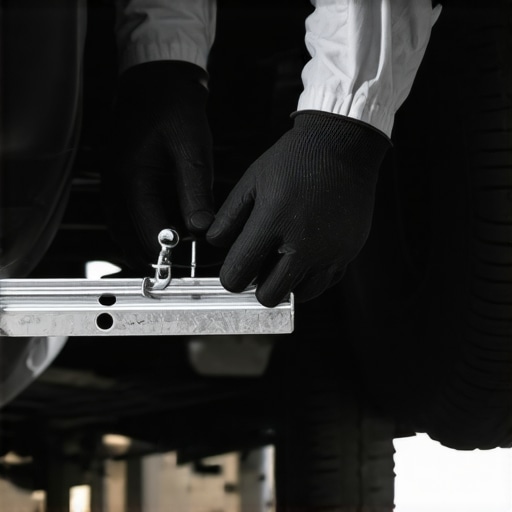
I was sitting at a red light in my old sedan last summer, trying to look cool, when the light turned green. As I tapped the gas, my car sounded like a skeleton having a seizure in a dumpster. That clack-clack-zing noise is the hallmark of a loose heat shield, and honestly, it makes you feel like your car is about to fall apart. It’s that specific, high-frequency vibration that makes people look at you as if your muffler is held on by a prayer. I know that feeling of dread, wondering if you’re looking at a thousand-dollar auto repair bill just to make the noise stop.
Stop the Noise Without Opening Your Wallet
Most folks assume that when a piece of the exhaust system starts acting up, it’s time for a major overhaul. I’ve been there. Early on, I made the massive mistake of assuming a rattle was a failing catalytic converter. I spent nearly $300 on a diagnosis and parts I didn’t need, only to realize the issue was a simple piece of thin aluminum that had vibrated loose. If you’ve ever noticed why your engine rumbles only when stopped in gear, you know how these vibrations can travel through the whole chassis. Today, we’re going to stop that rattle using nothing but things you probably already have in your junk drawer or garage. We aren’t just muting the noise; we’re ensuring your car stays safe. Interestingly, the National Fire Protection Association (NFPA) notes that vehicle fires can be prevented by maintaining these shields, as they stop the extreme heat of the exhaust from igniting road debris or grass. So, let’s keep that protection in place without spending a dime.
Is a free fix actually going to hold up?
You might be skeptical. Can a “free” fix really last longer than a week? The answer is a resounding yes, provided you use the right MacGyver-style tactics. This isn’t about duct tape—please, never use duct tape on an exhaust system. This is about mechanical fastening. Whether you’re working through a car service checklist or just trying to keep your daily driver quiet, this method is a permanent solution for a temporary-sounding problem. Have you ever tried to tighten a bolt only to have it crumble because of rust? That’s usually where most people give up and call the shop, but I’m going to show you why that’s exactly when the real DIY fun starts. Have you ever felt that sinking feeling when your car makes a noise you can’t explain?
Find the source before you touch anything
The first step is identifying exactly which shield is the culprit. Most cars have several—one over the manifold, one near the catalytic converter, and others shielding the fuel tank or spare tire well. To find it, give the exhaust system a gentle tap with a rubber mallet while the car is cold. If you hear that familiar metallic buzz, you’ve found your target. Sometimes why your car vibrates while you are sitting at a stoplight is down to one specific loose bolt rather than a failing engine mount. Once located, you’ll likely see the problem: a ‘pulled through’ bolt hole. Because heat shields are thin aluminum and the bolts are steel, galvanic corrosion eats away at the aluminum until the hole becomes larger than the bolt head, letting the shield flop around like a loose tooth.
The oversized washer miracle
If the bolt is still there but the shield has rotted away around it, don’t bother trying to unscrew the rusty bolt yet. Instead, look for a large ‘fender washer’ in your scrap bin. I once worked on a 2002 sedan where the bolt was so fused to the frame that even PB Blaster couldn’t budge it. I used a pair of tin snips to cut a slit in a wide, flat washer, slid it under the bolt head, and crimped it flat. That simple piece of metal provided a new, wider surface for the bolt to grip, pinning the shield back against the frame. This is a classic move when you are figuring out how to tell if your car needs a simple tune-up or a major repair; it’s a five-cent solution to a noise that sounds like a thousand-dollar disaster.
Secure the shield with the hose clamp method
When the mounting points are completely gone, your best friend is a stainless steel hose clamp. Think of this as a permanent metal zip-tie that can handle 1,000 degrees. You simply loop the clamp around the exhaust pipe and the loose shield, then tighten it down until the rattle stops. It’s effective because it provides 360-degree tension. I remember fixing an old truck this way back in college; I didn’t have a clamp, so I used a piece of heavy-duty steel bailing wire twisted tight with pliers. That ‘temporary’ fix was still holding perfectly three years later when I sold the truck. While auto repair trends to watch in 2025 focus on high-tech sensors, these mechanical basics are what keep older cars on the road safely.
Why you should never just remove the shield
It’s tempting to just rip the shield off and toss it, but that is a recipe for trouble. These shields protect your floorboards from the 1,200-degree heat of the catalytic converter. Without it, you might find your carpet melting or, worse, your engine vibrates while you are stopped at a red light because the excess heat is affecting nearby sensors or fuel lines. Always aim to secure it rather than discard it. If you’re doing a car service checklist, checking these shields for tightness should be right up there with checking your oil. A quiet car isn’t just about comfort; it’s about making sure your thermal protection is actually where the engineers intended it to be.
But solving a rattle is just the tip of the iceberg. Once you start crawling under your car, you begin to see how everything is interconnected. Many DIYers stop at the noise, but the real expertise comes in spotting the subtle signs of failure before they leave you stranded. One of the biggest misconceptions I see is the idea that modern cars are ‘maintenance-free’ because of their advanced computers. People think a ‘tune-up’ is a relic of the 1970s. However, the truth is that while computers can adjust for wear, they often mask underlying issues like vacuum leaks or carbon buildup until the damage is severe. You should focus on how to maximize your car’s lifespan with expert tune-up strategies rather than waiting for a check engine light. A study by the Car Care Council recently highlighted that nearly 80 percent of vehicles on the road are overdue for at least one critical maintenance item. If you ignore these, you aren’t saving money; you’re just deferring a much larger bill. Then there is the brake system. I cannot tell you how many times I have heard people panic because they smell something burning after a pad swap. There are plenty of brake service myths floating around, but the most common one is that ‘new’ means ‘perfect.’ If you do not follow the proper way to break in new brake pads and rotors, you can glaze the surfaces immediately, leading to poor performance. The real reason your new brake pads are smoking is often just the initial off-gassing of the resins, but if it persists, you likely have a seized caliper—a nuance many miss until their rotor turns a lovely shade of ‘expensive purple.’
Why does the pedal still feel soft after a full system bleed?
This is the question that separates the weekend warriors from the pros. If you have bled the lines and the pedal still feels like a marshmallow, you are likely dealing with an ABS internal bypass or a master cylinder bore that has developed a microscopic ridge. Most people assume there is just ‘more air’ in the lines, but on modern vehicles, you often need a bidirectional scan tool to cycle the ABS valves during the bleed process to truly clear the air. This isn’t just about ‘turning wrenches’ anymore; it is about understanding the fluid dynamics of a closed electronic system. Also, beware of the truth about budget spark plugs and engine performance; using the wrong heat range can cause pre-ignition that mimics a transmission shudder. Have you ever fallen into this trap? Let me know in the comments. Keeping your car in peak shape isn’t about luck; it’s about moving past the basics and respecting the machine’s complexity.
If you want to move beyond basic repairs, you need to upgrade your toolkit. I used to think a $20 OBD-II reader was all I needed, but then I hit a wall with an electronic parking brake that wouldn’t retract for a simple pad swap. To really master understanding brake system repairs, you eventually have to invest in a bidirectional scan tool. This isn’t just about reading codes; it is about commanding the car’s computer to open valves or test solenoids. Professional technicians rely on standards like the SAE J2534, which is the technical documentation standard for ‘pass-thru’ programming of a vehicle’s Engine Control Module (ECM). Without this level of access, you are essentially flying blind on anything made in the last decade.
Why a basic code reader just won’t cut it anymore
Most people don’t realize that their car’s modules are constantly talking to each other. When you perform a tune-up for peak performance, you might need to reset ‘fuel trim’ values or perform an idle relearn. A basic scanner can’t do that. I personally use a mid-range tablet-based scanner because it lets me graph live data while I drive. This is how you catch a failing oxygen sensor that hasn’t quite triggered a light yet but is killing your gas mileage. If you are serious about your garage time, you should also learn how to test your alternator with a simple multimeter at home. It is a foundational skill that saves you from replacing a $300 battery when the real culprit is a worn-out voltage regulator.
Stop the guesswork and start measuring heat
One of my favorite ‘pro’ tricks for diagnosing brake issues involves a $20 infrared thermometer. After a twenty-minute drive, I will hop out and point the laser at each wheel hub. If three rotors are 150 degrees and one is 450 degrees, I know exactly where the sticking caliper is before I even grab a jack. This kind of data-driven approach is what separates a parts-changer from a true mechanic. It is also a vital part of a car service checklist that actually prevents breakdowns. #IMAGE_PLACE_HOLDER_D#
How do I maintain my car’s health for the next decade?
Maintenance is not a one-time event; it is a lifestyle for your vehicle. You have to look at the real cost of skipping your 100,000-mile major service. It is not just an oil change; it is about timing belts, water pumps, and coolant flushes that prevent catastrophic engine failure. Looking ahead, I predict that within the next five years, we will see ‘predictive maintenance’ software become standard for DIYers, where your phone alerts you to a failing part before the car even knows it. For now, we rely on our eyes, our ears, and our data. I want you to try this: the next time you are under the hood, don’t just look for leaks—measure your battery voltage under load and log it. Tracking these small changes over time is how you maximize your car’s lifespan with expert tune-up strategies. It turns auto repair from a frantic response into a controlled, predictable science.
Hard Truths I Learned While Covered in Grease and Rust
After years of turning wrenches, I’ve realized that the most expensive repairs usually start as small, annoying noises we choose to ignore. If I could go back and talk to my younger self, I’d emphasize that preventative maintenance is a form of respect for your machine. I once spent an entire weekend pulling a cylinder head because I ignored a tiny coolant leak that led to a massive overheat. Now, I always keep a car service checklist handy to catch those ‘invisible’ failures before they turn into a crisis. Another big one? Never force a rusty bolt without heat or lubricant; snapping a stud turns a twenty-minute job into a two-day nightmare. Most importantly, I’ve learned that how to tell if your car needs a simple tune-up or a major repair often comes down to how much attention you pay to the subtle changes in how your car vibrates or smells.
The Gear That Actually Lives in My Daily Toolbox
You don’t need a professional shop to do high-quality work, but you do need the right set of eyes. Beyond the standard socket set, these are the items I never go without:
- An Infrared Thermometer: As mentioned, this is the ultimate tool for spotting a dragging caliper during a brake service or checking for a clogged radiator.
- A Digital Multimeter: Essential for electrical ghosts. You should learn how to test your alternator with a simple multimeter at home to avoid being stranded by a ‘dead’ battery that is actually fine.
- Model-Specific Forums: While YouTube is great, the deep-dive knowledge found in enthusiast forums for your specific make and model is worth its weight in gold.
Take the Keys Back from the Dealership
There is a unique sense of pride that comes from silencing a rattle or fixing a soft brake pedal with your own hands. It changes your relationship with your car from one of ‘fear of the unknown’ to one of ‘mastery of the mechanical.’ Whether you are performing a tune-up for peak performance or just pinning back a loose shield, you are taking control of your safety and your wallet. Don’t be afraid to get your hands dirty—every expert was once a beginner with a rattling exhaust and a dream. The ultimate car service guide isn’t just a book; it’s the experience you gain every time you open the hood. What was the most frustrating noise you ever fixed yourself? Let me know your victory story in the comments below!