

I was merging onto the interstate last summer, heart racing, as a massive tractor-trailer bore down on my bumper. I went to give it some gas, but the pedal felt like it was stuck in wet cement. I had to stomp it just to get a reaction, which sent the car jerking forward violently. It is a gut-wrenching feeling when your car stops responding to your touch, and it is a safety hazard that many people ignore until it is too late. My own experience with this was a wake-up call that maintenance isn’t just about oil changes.
Stop Fighting Your Accelerator and Start Driving Again
If you are currently dealing with a pedal that requires a heavy foot or feels crunchy under your toes, you are not alone. This isn’t just an annoyance; it is your car’s way of screaming for attention before a minor issue turns into a dangerous situation. Today, we are going to dive into the mechanics of why your throttle is resisting you, and I will show you how troubleshooting common auto repair issues at home can save you a massive headache later. We will look at everything from physical obstructions to the electronic sensors that might be lying to your engine.
Is a stiff pedal just a sign of an old car?
Many drivers assume that as a car hits the 100,000-mile mark, the controls naturally get heavy or unresponsive. That is a myth I fell for myself. Early in my DIY journey, I was convinced a stiff pedal meant a snapped cable or a transmission failure. I actually spent three days researching new gearboxes before realizing a simple cleaning was the real cure. The truth is, even a brand-new vehicle can suffer from a sticky pedal if environmental factors like salt or dust get into the wrong places. Have you ever felt that weird pop when you finally press hard enough to get the car moving? If so, I would love to hear about it—I want to know if yours feels worse when the engine is cold or hot.
The Hidden Gunk That Ruins Your Throttle Response
The most common culprit for that sticky sensation isn’t even under your foot—it is usually tucked away inside the intake system. Carbon deposits and oil vapor can create a gummy residue that prevents the throttle plate from pivoting freely. According to the Car Care Council, neglected maintenance is a leading cause of poor engine performance and unexpected safety issues. When that plate gets stuck, your pedal feels like it is resisting your foot because you are literally fighting against hardened sludge. To get things moving again, you usually need to clean your throttle body to restore response. Keeping a regular car service checklist is the absolute best way to catch these deposits before they harden into a real problem that requires a mechanic.
Move the Mat Before You Call a Mechanic
It sounds almost too simple to be true, but you would be shocked at how many ‘mechanical failures’ are actually just a thick winter floor mat bunched up under the pedal assembly. I once spent twenty minutes upside down in a footwell with a flashlight, only to realize my heavy-duty rubber mat had slid forward and was physically wedging the lever. Before you start unbolting parts, pull those mats back and see if the resistance vanishes. If the pedal still feels like it is fighting a spring-loaded brick, we need to look at the mechanical linkage. On older vehicles, the connection between your foot and the engine is a physical braided steel cable. Over time, the lubricant inside the cable housing dries out or attracts grit, making it feel like an old, rusty clothesline. If you suspect the cable is fraying, this is a safety priority that should top your car service checklist to prevent a stuck-open throttle.
Scrub Away the Sludge Behind Your Intake
If your car was built in the last fifteen years, you likely have an ‘Electronic Throttle Control’ system, or ‘drive-by-wire.’ In this setup, your pedal sends an electrical signal to a motor that opens the throttle plate. When this plate gets coated in oily carbon ‘coking,’ it sticks to the walls of the housing. You press the pedal, the motor tries to move the plate, it resists, and then suddenly snaps open—causing that dangerous jerking sensation. I remember working on a friend’s sedan that would practically lunge into traffic because of this. We spent ten minutes with a can of specialized cleaner and a microfiber cloth, and the difference was night and day. Learning how to clean your throttle body to restore response is arguably the highest-ROI maintenance task you can perform at home. 
Don’t Ignore the Pivot Point Under the Dash
Sometimes the gunk isn’t in the engine; it is right under your nose. The pedal itself rotates on a pivot pin that relies on a small amount of factory grease. Between the salt from your boots and the dust from the road, that grease can turn into a thick, abrasive paste. Grab a can of white lithium grease or a silicone-based spray. I found that a quick blast to the hinge mechanism on my old truck solved a ‘crunchy’ feeling I’d been living with for years. If you are already doing a tune up for peak performance, take two minutes to lubricate these moving parts. It is these small details that separate a car that feels ‘old’ from one that feels ‘refined.’
When the Computer Starts Lying to the Engine
If the physical pedal moves smoothly but the engine hesitates or stumbles, you might be dealing with a failing Accelerator Pedal Position (APP) sensor. This is essentially a sophisticated dimmer switch that tells the computer how much power you want. When the internal tracks of this sensor wear out, the signal becomes ‘noisy,’ and the car gets confused. If your check engine light is staring back at you, it is vital to know how to tell if your computer is giving you a false error code before you go out and buy an expensive sensor assembly. I’ve seen cases where how a simple tune-up fixed my mystery hesitation just by ensuring the electrical grounds were clean, proving that the solution isn’t always the most expensive part.Everyone tells you that a tune-up is the ultimate cure-all for a sluggish car, but here is the truth: the traditional ‘tune-up’ is dead. In the age of digital engine management, simply swapping plugs is often a waste of money if you haven’t addressed the underlying data. I’ve seen people throw hundreds of dollars at new sensors when the real culprit was a tiny $5 vacuum leak. In my experience, a ‘soft’ fix like a software reset or a deep cleaning often outperforms a hardware replacement.
Why does the check engine light come on for no reason?
It rarely comes on for ‘no reason,’ but it often points to a symptom rather than the disease. Advanced diagnostics require looking at fuel trims—the way your computer adjusts gas flow to compensate for air leaks. If you are trying to maximize your cars lifespan with expert tune-up strategies, you have to look beyond the dashboard lights. A common trap is the ‘Parts Cannon’ approach. I once watched a neighbor replace an entire fuel pump because of a hesitation issue, only to find out it was a corroded ground wire. Learning how to spot a bad ground wire causing electrical issues is a master-level skill that saves you from expensive, unnecessary repairs.
The Brake Myth That Leads to Uneven Stopping
Another major nuance involves your stopping power. Most drivers wait for a screeching sound before they even think about their pads, but there is a more subtle danger. A common myth is that ‘warped’ rotors are the only reason for a vibrating pedal. In reality, it is often uneven pad deposit caused by improper break-in procedures. If you don’t know the simple way to bed in new brake pads, you are setting yourself up for failure. A study by the National Institute for Automotive Service Excellence (ASE) highlights that technician error during initial installation often leads to ‘phantom’ vibrations that drivers blame on the quality of the parts rather than the process.
Stop Flushing Your High-Mileage Transmission
The same logic applies to your transmission. People think a ‘flush’ is a universal good, but on a high-mileage car, a high-pressure flush can actually dislodge debris that clogs the valve body. Understanding the real difference between a transmission flush and a drain and fill is the difference between a car that hits 300k miles and one that dies on the side of the road. Have you ever fallen into this trap where you replaced a part only to find the problem was something completely different? Let me know in the comments. By following a car service checklist, you can avoid these expensive mistakes and keep your ride running smooth.
Upgrade Your Toolbox Beyond the Basics
If you are serious about moving past the ‘oil change and hope’ phase of vehicle ownership, you need to invest in gear that gives you data, not just leverage. For years, I relied on a cheap $20 code reader from a big-box store, but it only told me half the story. To really get under the skin of modern systems, I eventually upgraded to a bidirectional scan tool. Unlike a basic reader, this allows you to command the car’s computer to perform specific tasks, like cycling an ABS pump or testing an EGR valve. It’s the difference between guessing a part is bad and knowing it is. When I was learning how regular tune-ups improve fuel efficiency and safety, being able to see real-time fuel trim data on my tablet changed everything. It turned my driveway into a legitimate diagnostic bay.
Smoke Out the Problems You Can’t See
One of my favorite ‘secret weapon’ tools is a portable smoke machine. We often talk about mechanical wear, but vacuum leaks are the silent killers of fuel economy. These tiny cracks in rubber hoses are nearly impossible to find with the naked eye. By injecting thick, harmless smoke into the intake, you can literally watch the wisps escape from the exact point of failure. I used to spray carb cleaner around the engine and listen for an idle jump, which is dangerous and imprecise. Now, I just use the simple way to check for vacuum leaks with smoke, and it has saved me dozens of hours and prevented me from replacing perfectly good sensors. If you want to maximize your cars lifespan with expert tune-up strategies, you have to stop the air leaks that make your engine run lean and hot.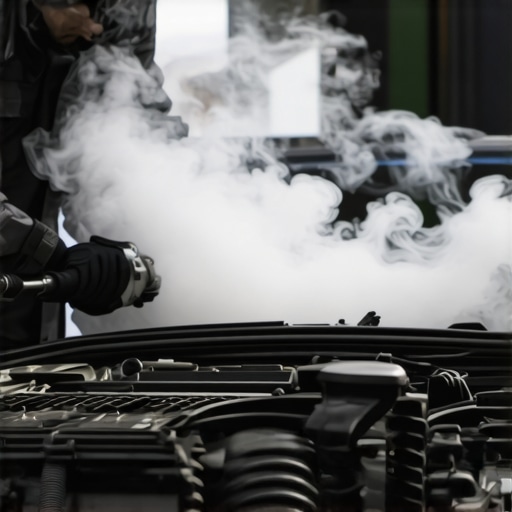
How do I keep a high-mileage engine purring for another decade?
Maintaining a car over the long haul isn’t about one big repair; it’s about the cumulative health of your fluids and rubber. As vehicles age, the plastic connectors and rubber seals become brittle from heat cycles. I make it a habit to perform the 5-minute check to prevent transmission failure every single month, looking for any change in fluid color or scent. According to technical documentation from SAE International, proactive fluid analysis can prevent up to 70% of catastrophic component failures. This isn’t just about the engine; your stop-and-go hardware needs love too. Before you head to a shop for a vibrating pedal, make sure you aren’t falling for brake service myths that suggest you need new rotors when a simple cleaning might suffice.
The Future of Your Driveway is Digital
Looking ahead, the landscape of DIY is shifting rapidly toward software. As we look at auto repair trends to watch in 2025, we are seeing more manufacturers lock down modules that previously required only a wrench. My prediction? In the next few years, ‘tuning up’ a car will involve as many firmware updates as it does spark plug changes. You will need to be as comfortable with a laptop as you are with a socket set. If you really want to stay ahead, my best advice is this: go out this weekend and perform a voltage drop test on your battery and ground wires. It is the single most effective way to prevent the ‘ghost’ electrical issues that plague modern cars. Try it once, and you’ll never look at a multimeter the same way again.
The Most Expensive Mistake I Ever Made in the Garage
I used to think that a stiff pedal or a weird vibration meant it was time for a major overhaul. I spent way too much money on parts I didn’t need before I realized that most car troubles are actually just a cry for basic maintenance. One of my biggest lightbulb moments was discovering that troubleshooting common auto repair issues usually starts with cleaning, not replacing. I learned that if you ignore the small things, like a sticky hinge or a carbon-coated intake, you end up paying for it later when the car goes into ‘limp mode’ on the highway. Always remember: the mechanical feel of your car is its only way of talking to you, so don’t ignore the feedback your feet are giving you.
My Must-Have Tools for Solving Mystery Vibrations
To move beyond the basic oil change, I had to upgrade what was in my toolbox. First and foremost, I recommend every DIYer get a bidirectional scan tool; it lets you see what the computer sees in real-time. I also swear by using the simple way to check for vacuum leaks with smoke to find those invisible air leaks that ruin your fuel economy. Finally, never underestimate a dedicated car service checklist to keep yourself organized. These tools didn’t just make me faster; they gave me the confidence to tackle a tune up for peak performance without worrying about breaking something important.#IMAGE_PLACE_HOLDER_E#
Stop Guessing and Start Knowing Your Machine
Walking into your garage should feel like stepping into a place of control, not a place of confusion. Whether you are dealing with a spongy brake or a resisting accelerator, remember that you have the power to fix it. By using expert tune-up strategies, you are not just saving money; you are extending the life of your vehicle and ensuring your family’s safety. Don’t be afraid to get your hands dirty—there is no better feeling than knowing your car is running perfectly because of your own hard work. Have you ever had a car problem that turned out to be something incredibly simple, like a loose floor mat or a dirty sensor? Let me know your story in the comments below!