

I’ll never forget the sinking feeling in my stomach after I spent a small fortune on a fresh set of tires for my old daily driver. I pulled out of the shop, hands light on the wheel, expecting that ‘cloud-nine’ ride. Instead, the car immediately tried to dive into the right-hand gutter like it was magnetically attracted to the curb. It’s frustrating, right? You pay for an upgrade and end up with a new headache. Most people assume the shop messed up the alignment, but I’ve learned the hard way that it’s rarely that simple. Today, I’m going to walk you through exactly why this happens—from ‘conicity’ to suspension quirks—so you don’t waste money on parts you don’t need.
Why Your Brand New Tires Are Trying to Steer You Into a Ditch
It feels like a betrayal. You’ve just invested in your vehicle’s safety, yet you’re fighting the steering wheel just to stay in your lane. When this happened to me, I drove straight back to the mechanic and demanded a re-alignment. The thing is, the alignment was perfect. This is where I made my biggest mistake: I assumed that because the tires were new, they couldn’t possibly be the source of the problem. In reality, why your car drifts to one side even on a flat road often comes down to something called ‘radial pull.’ It happens when the internal belts of a tire aren’t perfectly centered. Even high-end brands can have a bad apple in the bunch.
Is it actually possible for new tires to be defective?
It’s the question everyone asks when they’re staring at a hefty receipt. The answer is a frustrating ‘yes.’ According to the experts at the U.S. Tire Manufacturers Association, manufacturing variations can cause a tire to have a slight cone shape rather than a perfect cylinder. This is known as conicity. If that ‘cone’ is pointing to the right, your car is going to follow it. Have you ever felt like your car was fighting you more after you tried to improve it? Let me know in the comments, because I’ve been there and it’s maddening.
The One Mistake I Made When Assuming It Was Just the Alignment
Early in my DIY days, I threw money at a second alignment and even an unnecessary brake system repair thinking a caliper was sticking. I didn’t realize that simply swapping the two front tires could have diagnosed the issue in ten minutes. If the pull changes direction when you swap the tires, you’ve got a tire issue, not a mechanical one. Before you go booking a full car service, we need to rule out the simple stuff like tire pressure or the hidden reason your new tires are noisy. Sometimes, learning how to tell if your wheel alignment is actually off is less about the machine’s read-out and more about how the rubber meets the road. We’re going to dig into the technical reasons your car behaves this way and how to talk to your tire shop so they actually listen to you.
Check Your PSI Before You Blame the Shop
You might think it is too simple to be the culprit, but uneven tire pressure is the most common reason for a sudden drift. Think of your tires like the legs of a table; if one is just slightly shorter, the whole thing becomes unstable. Even a 2 or 3 PSI difference between the left and right front tires can create enough of a leverage gap to pull the steering wheel. This is why why your low tire light blinks instead of staying solid is often a signal that one tire is just far enough out of spec to affect your handling. Before you touch a single bolt, get a high-quality digital gauge and ensure both front tires match the placard inside your driver’s side door jamb exactly.
The Simple Swap That Saves You Hundreds
If the pressure is perfect and the car still wants to dive into the shoulder, it is time for the ‘Cross-Rotation Test.’ This is the definitive way to prove whether the issue is the tire or your vehicle’s mechanical state. I remember a specific Saturday afternoon spent on my driveway with a 2005 sedan that felt like it was trying to turn a permanent right corner. I was convinced the rack and pinion were toast. I spent twenty minutes swapping the front left tire with the front right. Suddenly, the car pulled to the left. That instant reversal proved it was a ‘radial pull’ caused by an internal belt defect. 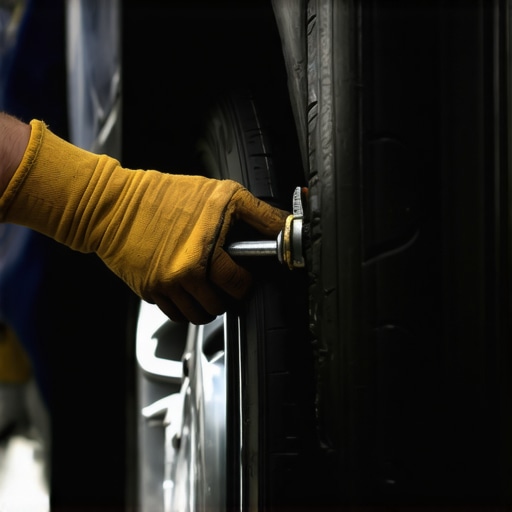 By identifying this yourself, you can avoid paying for a full car service you don’t actually need. If the pull stays on the same side after the swap, the problem is your alignment or suspension. If the pull moves with the tire, you take that tire back to the shop and demand a warranty replacement. Knowing why your car pulls to the right only when accelerating versus a constant drift helps you narrow down these internal tire failures quickly.
Look Past the Rubber at Your Suspension and Brakes
Sometimes, the act of installing new tires—which are heavier and have more grip than your old, worn-out ones—simply highlights a pre-existing mechanical flaw. A dragging brake caliper is a prime example. If one caliper isn’t fully retracting, it creates constant friction on that side of the car. You can check this easily after a ten-minute drive; if one wheel feels significantly hotter than the other, you are likely looking at brake system repairs rather than a tire defect. Similarly, check for a collapsed brake hose, which can trap pressure and keep the pads pressed against the rotor.
Verify the Wheel Alignment Yourself
Don’t just trust the printout the shop gives you. You can perform a basic visual check by looking at your steering wheel while driving on a perfectly flat, empty parking lot. If the wheel is centered but the car wanders, your ‘toe’ setting is likely the issue. If the wheel is crooked but the car goes straight, the shop didn’t center the steering wheel during the alignment. It’s also worth checking why your brake fluid levels keep dropping if you suspect a hydraulic issue is affecting your calipers. By troubleshooting common auto repair issues before visiting the shop, you enter the conversation as an informed owner. Use a car service checklist to document your findings. When you tell a technician, ‘I swapped the front tires and the pull changed sides,’ they know they can’t upsell you on an alignment—they have to fix the defective rubber.
I see it all the time in DIY forums: someone’s car is running a bit rough, so they immediately buy a ‘tune-up’ kit. Here is the contrarian truth that most shops won’t tell you: the traditional ‘tune-up’ died in the 1990s. Modern engines are managed by complex computers that adjust timing and fuel flow on the fly. If your car is acting up, throwing a set of spark plugs at it without a scan is just ‘parts cannon’ engineering. In my experience, a rough idle is more often solved by how to clean your throttle body to restore throttle response than by replacing expensive ignition components. We need to move past the 1970s mindset if we want to maximize your car’s lifespan with expert tune-up strategies.
The expensive trap of ‘Pad-Slapping’ your brakes
The biggest ‘oops’ factor I see with brakes is what we call ‘pad-slapping’—simply putting new pads on old, un-resurfaced rotors. You might think you’re saving money, but you’re actually setting yourself up for brake fade and annoying squeals. Most people assume that if the pedal is firm, the job is done. However, brake service myths often lead owners to ignore the brake hardware and slide pins. If those pins are seized, your new pads will wear unevenly in weeks. According to a study by the National Institute for Automotive Service Excellence (ASE), over 40% of brake noise complaints are traced back to improper installation and lack of lubrication rather than defective pads. If you don’t take the time for the simple way to bed-in new brake pads, you’re never going to get the performance you paid for. Have you ever fallen into this trap of replacing the part but ignoring the system? Let me know in the comments.

Can a failing sensor trick you into a $1,000 mechanical repair?
This is where things get sophisticated. I once worked on a car where the owner was quoted for a full master cylinder replacement because of a ‘spongy’ pedal. It turns out, it was just a failing ABS wheel speed sensor causing the pump to cycle incorrectly. Before you commit to heavy brake system repairs, you must rule out the electronics. You should know how to tell if your master cylinder is failing internally versus a simple hydraulic leak. Sometimes, the hidden culprit behind a spongy brake pedal is actually air trapped in the ABS secondary valve, which requires a digital scan tool to bleed—something your average driveway bleed won’t fix. Always check your car service checklist to ensure you aren’t skipping the diagnostic phase. By troubleshooting common auto repair issues before visiting the shop, you prevent the technician from jumping to the most expensive conclusion first.
If you are serious about avoiding unnecessary trips to the shop, you need to stop relying on those cheap, $20 Bluetooth dongles from the bargain bin. While they are fine for clearing a gas cap code, they lack the bi-directional control needed to test individual components like a fuel pump or an ABS solenoid. I personally use a mid-range tablet-based scanner that allows me to perform ‘active tests.’ According to the Society of Automotive Engineers (SAE) in their J1939 standards, consumer-grade readers often fail to capture high-fidelity ‘freeze frame’ data—the snapshot of exactly what was happening when a fault occurred—leaving you guessing. Knowing how to tell if your computer is giving you a false error code becomes much easier when you can see the live data stream for yourself. 
The maintenance rituals that actually double your engine life
Most people think an oil change is the beginning and end of engine care. In reality, the secret to getting 200,000 miles out of your original engine is found in the stuff people ignore, like the intake system and electrical grounds. I swear by the hidden benefit of cleaning your mass air flow sensor every time you change your air filter. This simple habit prevents ‘rich’ or ‘lean’ conditions that eventually kill your catalytic converter. To truly maximize your car’s lifespan with expert tune-up strategies, you need to treat a tune-up for peak performance as a comprehensive system check, not just a parts replacement list.
How do I maintain my car’s performance for the long haul?
It comes down to fluid chemistry and mechanical hygiene. Beyond the engine, you must look at your chassis and safety systems. I always recommend troubleshooting common auto repair issues before visiting the shop by keeping a dedicated logbook of every vibration or sound you hear. This allows you to spot trends before they become failures. Looking at auto repair trends to watch in 2025, we are seeing a massive shift toward software-locked components. In the future, ‘wrenching’ will involve as much coding as it does socket sets. Even now, some cars require a digital ‘handshake’ just to register a new battery. If you aren’t investing in tools that can communicate with these modules, you will be locked out of your own vehicle’s maintenance. Try this: Next time you rotate your tires, use a torque wrench to follow the proper way to torque wheel bolts without a manual. It prevents warped rotors and keeps your car’s handling predictable for years.
The Hardest Lesson I Learned About Trusting the Shop’s Computer
Over years of wrenching, I’ve realized that the alignment machine is only as good as the person operating it. The most frustrating lesson was learning that a ‘green’ printout doesn’t always mean a straight-tracking car. Sometimes, auto repair is more of an art than a science. Here is what I wish I had known sooner: First, never skip the test drive with the technician. If you feel a pull, don’t let them tell you it’s ‘just the road crown.’ Second, the first 50 miles after any car service are the most telling; pay attention to every vibration. Finally, stop thinking of a ‘tune-up’ as a single event. It is a continuous process of observation. I’ve seen how regular tune-ups improve fuel efficiency and safety more than any one-off performance part ever could.
My Essential Toolkit for Keeping Your Ride Smooth
If you want to stop guessing and start fixing, you need more than just a basic socket set. I personally trust a bi-directional scan tool because it lets me talk to the car’s computer to see if a sensor is lying. For those dealing with mystery drifts, a high-quality digital tire pressure gauge is non-negotiable. I also recommend keeping a copy of your vehicle’s specific factory service manual—not just the generic ones—to understand the unique quirks of your suspension geometry. If you are tired of wondering why your car wanders across the lane at high speeds, these tools will give you the data you need to challenge a shop’s diagnosis. I also suggest keeping a dedicated logbook; it was the unexpected reason my car failed the inspection once, and I’ve documented every bolt turn since then.
Take the Wheel of Your Own Maintenance
You don’t need to be a certified master tech to have a safe, reliable vehicle. By understanding the basics of brake service and how tires interact with your suspension, you are already ahead of 90% of the drivers on the road. Don’t be afraid to get your hands dirty or ask the ‘stupid’ questions at the shop. Real auto repair is about being an advocate for your own machine. Whether you are performing brake system repairs or just checking your own fluids, you’re taking control of your safety. #IMAGE_PLACEHOLDER_E# If you ever feel stuck, you can always contact us for guidance. Remember, your car is an investment that pays you back in reliability every time you treat it with respect. Have you ever had a shop tell you everything was ‘in spec’ even though you knew the car was pulling to one side? Let me know your story in the comments below.