

It was 11:30 PM on a Tuesday, and I had just finished the long, winding drive home in my old sedan. I twisted the key, pulled it out of the ignition, and stepped out into the crisp night air, expecting total silence. Instead, I was met with a roar. My radiator fan was spinning like a jet engine, even though the engine was stone cold dead. I stood there for ten minutes, hovering over the hood, wondering if my car was about to melt or if I’d be walking to work the next day. I felt that familiar pit of anxiety in my stomach—the kind you get when you realize you might have a hidden drain that kills your battery while the car is parked. Today, I am going to save you that stress by explaining exactly why your car keeps breathing long after you’ve walked away and how to tell if it’s a normal feature or a cry for help.
Your Car Isn’t Possessed It’s Just Cooling Down
Most modern vehicles are smarter than we give them credit for. When you shut off your engine, the water pump stops circulating coolant, but the block is still radiating intense heat. To prevent ‘heat soak’—which can warp components—the computer triggers an after-run cycle. It is a vital part of troubleshooting common auto repair issues before visiting the shop. Have you ever stood by your car and wondered if that noise was going to eventually stop, or did you end up popping the hood like I did?
Will this leave me stranded with a dead battery?
This is the biggest fear every driver has. We see a fan running and we see dollar signs for a new battery or an alternator. In most cases, if the fan shuts off within 5 to 10 minutes, your battery is perfectly safe. However, if that fan stays on until the battery is drained flat, you likely have a stuck relay or a faulty temperature sensor. According to experts at the Society of Automotive Engineers (SAE), ‘after-run’ cooling cycles are specifically designed to protect the integrity of the cylinder head gaskets and turbochargers.
Why My Four Hundred Dollar Mistake Should Be Your Free Lesson
Years ago, I panicked when my fan wouldn’t shut off. I didn’t know the reason your engine fans keep running after the car is off could be something as simple as a $15 relay. Instead, I blindly replaced the entire fan assembly and even considered a new radiator. It was an expensive lesson in ‘check the simple stuff first.’ I could have easily checked if my thermostat was the culprit by using the test your own thermostat in a pot of boiling water trick, but I was too impatient. Don’t be like younger me. We’re going to walk through the logic of your cooling system so you can keep your cash in your pocket.
Stop the Drain Before Your Battery Dies
To stop your car from eating its own battery, you have to act within that critical twenty-minute window after you park. Think of your cooling fan relay as a gatekeeper. Normally, it opens the gate to let electricity through when the engine is hot and shuts it when things cool down. But relays are mechanical; they can physically ‘weld’ themselves shut. If your fan is still screaming after fifteen minutes, open your hood and find the fuse box. I once sat in a grocery store parking lot for forty minutes, terrified that if I walked away, my car wouldn’t start when I came back. I didn’t know then that the reason your engine fans keep running after the car is off is often just a sticky fifteen-dollar relay. Use the diagram on the underside of the fuse box cover to locate the ‘Cooling Fan’ or ‘Rad Fan’ relay. Give it a firm tap with the handle of a screwdriver. If the fan suddenly stops, you’ve found your culprit. This ‘percussive maintenance’ works because the vibration breaks the small weld inside the relay, but don’t consider it fixed—replace that relay immediately before it sticks again and leaves you stranded. 
Tap the Relay to Find the Sticky Culprit
If tapping doesn’t work, pull the relay out entirely. If the fan stops, the relay is likely the issue. If the fan keeps spinning even with the relay in your hand, you have a short in the wiring, which is a much bigger headache. This is a core part of maximize your cars lifespan with expert tune up strategies because ignoring electrical gremlins eventually fries your alternator. When I was first learning, I actually pulled the wrong relay—the one for the fuel pump—and couldn’t figure out why the car wouldn’t start the next morning. Label your parts! It is a simple step that saves hours of frustration.
Stop Chasing Ghosts with a Simple Computer Reset
Sometimes the hardware is fine, but the ‘brain’ of the car is confused. Modern cars use a Coolant Temperature Sensor (CTS) to tell the computer how hot the engine is. If that sensor is sending garbage data, the computer defaults to ‘failsafe mode,’ which means running the fans at 100% to prevent a meltdown. You can check if the sensor is the liar by seeing how to tell if your computer is giving you a false error code using a basic OBD-II scanner. If the scanner shows the engine temperature is 210 degrees while the car has been sitting for three hours, the sensor is dead. Replacing it is usually as easy as unplugging a wire and unscrewing a brass plug.
When a New Part is the Only Solution Left
If you’ve tested the relay and the sensor and the fan still won’t quit, it might be time for more serious tune up your car for peak performance essential maintenance tips. In some vehicles, the fan controller is built into the fan motor itself. When these modules fail, they fail ‘ON.’ While it sounds daunting, learning how to replace your own alternator and save hundreds gives you the confidence to swap out a fan assembly too. I remember my first fan swap—I forgot to bleed the air out of the cooling system afterward and nearly overheated the engine on the test drive. Always remember to check your fluid levels and use the test your own thermostat in a pot of boiling water method if you’re already draining the system. It’s better to spend ten extra minutes in the kitchen than two hours on the side of the highway.Most people still walk into a shop asking for a ‘tune-up,’ but here’s the cold truth: the traditional tune-up died with the carburetor. Modern car computers handle the timing and fuel mixture thousands of times per second. When you follow the old-school logic, you end up throwing money at spark plugs when the real issue is often a hairline crack in a plastic hose. I’ve seen countless DIYers spend a weekend replacing ignition coils only to find out they could have learned how to identify a vacuum leak using a simple cigar for the price of a gas station stogie. The nuance lies in shifting your mindset from ‘replacing parts’ to ‘verifying systems.’ This is the heart of how to maximize your cars lifespan with expert tune up strategies.
Stop Chasing the Ghost of the 1970s Tune-Up
The biggest trap in modern maintenance is believing that a ‘service’ is just a checklist of oil and filters. In reality, the most critical part of an auto repair schedule is the inspection of rubber components and electrical grounds. If your ground wire is corroded, it doesn’t matter how many new sensors you buy; the data will still be garbage. I once spent three days diagnosing a rough idle on a client’s truck, only to find a loose ground wire behind the cylinder head. Have you ever fallen into this trap where you replaced a perfectly good part just because a forum post told you to? Let me know in the comments.
Why Quiet Brakes Start with a Heat Cycle
Another massive misconception involves brake service. Most people think that once the new pads are clamped in, the job is finished. This is how you end up with glazed rotors and annoying squeals. You must perform a bedding-in process to transfer a layer of friction material onto the rotor surface. Without the proper way to break in new brake pads and rotors, your high-end ceramic pads will perform worse than the cheapest budget options. Don’t fall for the ‘plug and play’ myth; brakes require a thermal ‘handshake’ between the pad and the metal to work correctly. It’s one of the most overlooked brake service myths in the industry. 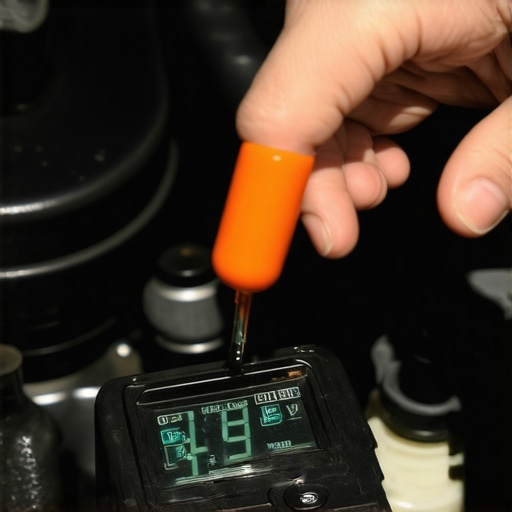
Is your mechanic checking for copper or just looking at the color?
Advanced technicians know that the color of your brake fluid is a terrible indicator of its health. While most people panic because their fluid is dark, the real danger is dissolved copper and moisture content. Brake fluid is hygroscopic, meaning it literally sucks water out of the air. A study by the Car Care Council revealed that nearly 80% of vehicles on the road have at least one unperformed maintenance item, with fluid contamination being a silent leader. If you see why your brake fluid looks like coffee creamer, you aren’t just looking at old fluid; you are looking at a system that is actively corroding your ABS pump from the inside out. Using a digital moisture tester is the only way to be sure. This level of detail is what separates a basic oil change from a professional car service checklist that actually protects your investment. Stop guessing and start measuring.
Put Down the Wrench and Grab a Data Scanner First
For years, I thought I could solve every problem with a basic socket set and a bit of intuition. I was wrong. The moment I started using an OBD-II scanner was the moment I stopped being a ‘parts-cannon’ mechanic who just threw new components at a problem until it went away. If you want to get serious about troubleshooting common auto repair issues before visiting the shop, you need to see what the computer sees. I personally use a Bluetooth-enabled adapter because it lets me log data while I’m actually driving. This is how I discovered that my ‘engine stutter’ wasn’t a bad spark plug, but a tiny drop in fuel pressure that only happened under load. By learning how to tell if your computer is giving you a false error code, you save yourself from the most expensive mistake in DIY: replacing perfectly good sensors.
Precision Tools Save Your Threads and Your Wallet
Another tool I will never live without is my digital torque wrench. I used to think ‘hand-tight’ was a universal measurement, but modern aluminum engines are incredibly sensitive to uneven pressure. Whether you are working on a valve cover or learning the proper way to torque wheel bolts without a manual, precision is your best friend. A single over-tightened bolt can strip a thread in the engine block, turning a twenty-minute job into a two-day nightmare. According to the Automotive Service Excellence (ASE) Advanced Engine Performance manual, nearly 30% of secondary mechanical failures are caused by improper torque during a previous repair. Don’t leave your engine’s life to a ‘gut feeling.’ 
How do I maintain my car’s peak performance as the odometer climbs?
The key to reaching the ‘high-mileage club’ isn’t luck; it’s a shift from reactive to proactive maintenance. Most people wait for a light to pop up on the dashboard before they act. Instead, you should be looking for the secret to getting 200,000 miles out of your original engine by tracking the health of your fluids and rubber components. For example, knowing the real difference between a transmission flush and a drain and fill can prevent you from accidentally damaging a fragile older gearbox. Consistency beats intensity every time.
Software is the New Spark Plug
As we look toward the future, the definition of a ‘tune-up’ is shifting entirely. My prediction is that by 2030, physical maintenance like changing oil will be secondary to software optimization and battery health management. We are already seeing this in auto repair trends to watch in 2025, where over-the-air updates can actually fix a shifting issue in your transmission without a mechanic ever touching a wrench. However, the basics of heat and friction will never change. Even a car that drives itself still needs someone to ensure the proper way to break in new brake pads was followed. I challenge you this weekend to do one thing: spend $20 on a digital brake fluid moisture tester and check your reservoir. It is the easiest way to see the invisible damage happening inside your lines right now.
The Hardest Lesson My Engine Ever Taught Me
It took me years to realize that a vehicle is just a collection of systems trying to talk to you through sound and vibration. When I finally stopped treating my engine like a mysterious black box and started treating it like a series of logic puzzles, the anxiety of the ‘Check Engine’ light disappeared. Here are the core truths I’ve gathered from decades under the hood. Verification is always cheaper than speculation. If you think a sensor is bad, prove it with a multimeter before you reach for your wallet. The loudest noise isn’t always the biggest problem; often, the most terrifying sounds come from simple fixes like a loose bracket or a failing relay. Most importantly, heat is the silent killer of every component. Keeping your cooling system healthy is the single best way to improve fuel efficiency and safety over the long haul. I used to think ‘good enough’ was okay for maintenance, but your car’s lifespan is directly tied to the precision of your care.
Gear That Actually Makes a Difference in Your Garage
If you’re going to dive into troubleshooting common auto repair issues before visiting the shop, you need more than just a set of standard wrenches. I swear by my Bluetooth OBD-II scanner because it turns your smartphone into a real-time diagnostic powerhouse. I also suggest keeping a digital multimeter handy; it is the only way to truly test those sticky relays we discussed. Finally, never underestimate the power of a physical car service checklist. It’s the only way to ensure you don’t forget the small, critical steps—like checking the moisture level in your brake fluid or inspecting the date codes on your tires—that prevent catastrophic failures later.
You Are More Capable Than Your Cars Computer Thinks
Owning a vehicle shouldn’t feel like a hostage situation where you’re just waiting for the next expensive repair bill. When you take the time to learn the ‘why’ behind the ‘what,’ you gain a sense of control that no service center can sell you. Whether you’re investigating the truth about 10,000 mile oil change intervals or just trying to stop a cooling fan from draining your battery overnight, you’re doing the essential work to keep your machine alive. Don’t be afraid to get your hands dirty and ask questions. Every expert was once a beginner standing over a hot engine with a confused look on their face. Have you ever been completely stumped by a car noise that turned out to be something incredibly simple? Let me know in the comments below!